
Swiss psychiatrist makes the case for more female pilots

pilotinnen

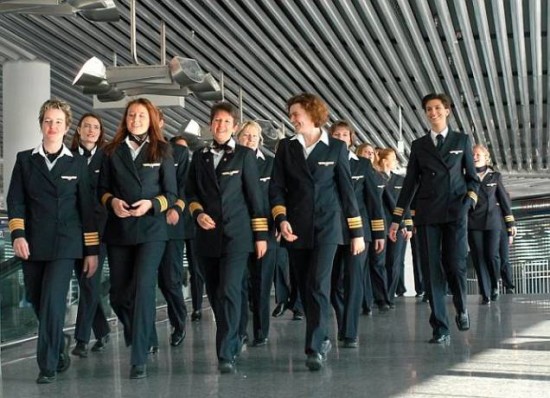
Female pilots of Lufthansa, photographed for the airline by Rolf Bewersdorf. Why aren’t there more of them? According to an article in Schweiz am Sonntag (via EMMA), there should be more women pilots, because they are actually the more trustworthy sex. And more to the point, according to a leading Swiss expert on suicide, it’s because they are more in control of themselves emotionally speaking, and less likely to commit suicide on the job:

As a pilot, train engineer or bus driver, the responsibility is huge, because passengers trust them with their lives. Above all, men hold these positions. Of Swissair’s 1,341 pilots, only 59 are women. A similar gender relationship shows itself in SBB (Swiss rail) and the Postbus: of 3,500 train engineers, 80 are women, and of 3,079 Postbus drivers, 245 are women.

Gabriela Stoppe regards this share as much too low. She is a psychiatrist and vice-president of Ipsilon, the umbrella organization for suicide prevention in Switzerland.

“It would make sense not only for diversity, but for safety, to have more women in human transport,” says Stoppe. She bases her statement on the fact that women have lower rates of suicide. “It was only a matter of time that a pilot would commit suicide with an airplane in Europe, too.”

As unbelievable as the case of the Germanwings crash may be, in the past decades there have been several crashes in which pilots killed themselves with their planes. Six are documented.

In Switzerland, suicide is the number one cause of death for men between the ages of 14 and 44. In 2012, 240 of them took their lives. Although the number of self-inflicted deaths has gone down a bit in the last ten years, three times as many men as women take their own lives still. “This should be taken into account in choosing a pilot, driver or engineer,” says Stoppe.

On Tuesday at 10:30 a.m., co-pilot Andreas L., 27, begins the descent over the French Alps. The Germanwings Airbus A320 rapidly loses altitude. The captain is locked out of the cockpit, he can’t do anything anymore. After eight minutes the plane crashes. All 150 persons die.

“Many signs point to a take-along suicide,” says Stoppe. A rare form of suicide. “Often it’s fathers or mothers, who don’t only kill themselves, but also their children and their partners. That someone would take several passengers along is unusual.”

The psychiatrist imagines it went like this: When Andreas L. got the opportunity to put his thoughts into realization, he shut down mentally and emotionally. In the moment of a suicidal crisis, people only have tunnel vision. And as with rampage-runners, there is no way back.

The Düsseldorf police don’t find a suicide note during their search of Andreas L.’s apartment. But they do find torn-up doctors’ notes, current, and even dated the day of the crash, as well as several medications for the treatment of psychiatric illnesses. The co-pilot also suffered from vision problems. The investigators conclude “that the deceased hid his illness from his employer and co-workers.”

This doesn’t surprise Gabriela Stoppe. “Precisely those people who fear that they will lose their job due to a mental illness don’t dare speak of it.” Often, such people will also refuse to take medication, so as not to be detected during drug testing. “Depression and other mental illnesses are, as ever, a taboo in certain professions and careers.” That leads to only about 60% of those affected reporting such illnesses. “Meanwhile, 80 to 90% of such cases would be successfully treatable.”

Nowadays, the airline doctor checks the mental health of pilots during their aptitude tests. Yearly medical checkups follow. A similar procedure takes place with railroad and bus drivers. Bus-driver candidates are tested mainly for resiliency, observational capacities, and also for aggressive tendencies, while locomotive engineers are tested for how well they handle solitude and repetitive tasks.

That alone won’t do, Gabriela Stoppe is convinced. Psychological testing is still necessary in later career phases. And particularly from doctors trained in psychiatry. “Highly intelligent people are particularly likely to conceal such serious problems as paranoid hallucinatory psychoses,” says a Munich psychiatrist, Helmut Kolitzus, in Der Spiegel.

Swissair is currently debating whether to psychologically test their pilots once a year.

Translation mine.

No word on what Lufthansa’s current psychological testing policies are, or how they’ll change, but the fact that Swissair sees a need to change theirs is telling. As is the fact that Andreas L. had several torn-up doctor’s notes in his wastebasket. Clearly not a company doctor, because he was expected to take those notes to his supervisor himself, and he didn’t. Maybe Lufthansa/Germanwings needs to employ a company shrink, one who reports directly to supervisors of the pilots if there is any problem? Because in this case, the patient was trusted to do the appropriate thing…and because he was clearly fearful of losing his dream job, the only one he ever wanted, he chose instead to conceal his condition until it was too late. 150 people paid with the senseless loss of their lives for the unwillingness of one to step back for his mental health’s sake.

But why would more female pilots be an answer to problems like that? Simple: Because while women are more likely to be depressive, and also more likely to attempt suicide than men, they are also less likely to actually die that way. They tend to choose less violent methods, ones which are more readily reversed: an overdose of pills, say, instead of a gun or a vehicle crash. A female suicide attempt is not a melodramatic “bid for attention”, as it’s often dismissed as being; rather, it’s a last, desperate cry for help. And for that reason, a woman who tries to take her own life is more likely to get help, in the end — simply because her suicide method is less likely to “succeed”.

Men, on the other hand, ironically succeed at killing themselves because they are socialized from infancy up to be more aggressive — and by that token, “successful”. They are taught to pursue what they want at any cost, even if it’s unreasonable — eg., a career as a commercial pilot when they are too emotionally labile to handle the stresses — or if it’s death. Extreme behavior is less frowned upon in a boy than a girl, and less so in a man than in a woman, as well. Risk-taking is more praised in males than in females. If a man is violent, “boys will be boys” is the excuse most likely to be waved around.

Should a woman do the same, however, suddenly it’s “bitches be crazy”.

This is all in line with popular stereotypes. A boy with “leadership attributes” is lionized; a girl with the same attributes is hand-waved off as “bossy”. Little wonder, then, that the transport industry is dominated by male drivers, engineers and pilots. It’s not that women can’t work a set of controls (one doesn’t have to be bigger or stronger or endowed with a penis to grasp a steering wheel, after all); it’s that women are more likely to be discouraged from an early age of even thinking of entering those jobs. Because they’re not “mentally fit” for them. Because “hormones”. Never mind that the worst case of PMS doesn’t turn a woman into a deranged psychopath; at most, it puts her bullshit-tolerance on a par with that of the average man, whose hormone levels of course are never blamed for anything. No, bitchez be the crazy ones. Cray-cray-ba-nay-nay.

It is time to stop gaslighting girls out of careers in the transport industry. Because one of our best attributes, ironically, is the very one that’s been used to deny us piloting jobs in the past: yup, our ever-fluctuating, blameworthy hormones. We’re so good at riding out those little physical ups and downs, it actually makes us more mentally stable, not less. We become more careful and more conscientious as a result. And we are more likely to seek help if we need it, too. Female pilots, to date, have caused 0 (count ’em, ZERO) suicide crashes. Surely that’s a significant statistic right there. Why doesn’t the industry seize on that, and recruit more female pilots?

To “fight like a girl” to keep a job one loves means to take a break if one needs it, and return to work later…instead of doing the type-A macho thing and hiding one’s problems until suddenly the plane is in a death dive, and there is no turning back.


Share this story:
Posted in Confessions of a Bad German, Economics for Dummies, EuroPeons, If You REALLY Care, Isn't It Ironic?, She Blinded Me With Science, Uppity Wimmin | Comments Off on Swiss psychiatrist makes the case for more female pilots

Music for a Sunday: Talk about hosanna

See if you can keep from crying at the last line of this one. I never could.

Share this story:
Posted in Music for a Sunday, Uppity Wimmin | Comments Off on Music for a Sunday: Talk about hosanna

Bill C-51: Are you on Harpo’s enemies list yet?

If not, shame on you. Watch this and learn why it behooves you to become an enemy of PetroState Canada and Fortress North America:

Democracy, freedom of speech, freedom of religion and political association, the indigenous peoples, the right to a clean and healthy environment…all these and more are now under fire. And if you believe in them, and take your belief in them to the streets, congratulations: You are An Enemy of the State. USA PATRIOT Act North, otherwise known as Bill C-51, is aiming to make YOU illegal.

And if you couldn’t make it to the streets, don’t worry. You can still put a fire under your Member of Parliament. Use this letter-writing tool and in a few minutes’ time, you too can be a proud member of the Enemies list.

Now go, and be the best fuckin’ subversive you can.

Share this story:
Posted in Barreling Right Along, Bullies, Canadian Counterpunch, Environmentally Ill, Fascism Without Swastikas, If You REALLY Care, Isn't That Illegal?, Isn't That Racist?, Law-Law Land, Not So Compassionate Conservatism, Spooks, Teh Injunz, The United States of Amnesia | Comments Off on Bill C-51: Are you on Harpo’s enemies list yet?

In Germany, fear is prostitution’s constant companion

sex-harrassment

Remember how, back in 2002, progressives from all over the world heralded Germany’s suddenly liberalized prostitution laws? Finally, they said — the “oldest profession” would become a job just like any other! Unionization! Freedom of sexual expression! Workers’ rights for sex workers! Street prostitution will become a thing of the past! Everyone will work independently indoors, where it’s safe! And on and on.

Well, that hasn’t happened. What happened instead is that this well-intended but badly flawed legislation came together with the neocapitalism of Eastern Europe in a perfect storm of open borders, organized crime, and near-total impunity. So what effect has all of that had? The Frankfurter Rundschau news team went on the streets, and what the women there have to say may shock you…

The well-tended, good-looking woman — let’s call her Anna* — knows whereof she speaks. “Ever since the East Bloc arrived, prices are kaputt. Lots of johns are really shameless. Everything’s turned around: once, the ladies named their price. Today, the men tell them what they’ll give. And if I say ‘I won’t do it for 15 euros, and definitely not without a condom’, then he’ll keep on driving. And later he’ll honk going by, to show me that he found a Bulgarian or a Romanian who will do what he wants.”

Anna is prostituting. For 25 years, as she herself says. It’s cold this evening on the street corner of the Theodor-Heuss-Allee in Frankfurt. Anna stands there in an open down jacket, with a low neckline and high boots. It all comes bubbling out of her: “Ever since I started, lots of things have gotten worse. Respect is gone. But it’s all right for me, I have lots of regulars and don’t have to hop into every car. In the end, you just don’t want to do everything.”

Not everyone radiates so much self-assurance. 100 metres away is Anna’s transsexual colleague, Mia*, who’s happy just to have 50 euros in her pocket at the end of the night. “For having sex twice.” Five years earlier, she used to make several hundred euros a night, says the Bulgarian with the big, sad eyes. She earns a little extra with table-dancing. Otherwise, she has to stand on the curb.

“Earning good money fast” — you can still do that, says pretty young Dana*, on the other hand. Seven months ago, she quit her job as head salesclerk in a supermarket in Bulgaria — “badly paid 12-hour days”. Today she earns a lot more (“25 euros for 15 minutes”) and is, so she says, content. If only she weren’t afraid. Above all, of sexually transmitted diseases and HIV.

Dana keeps hearing from the men that they’re married, after all, and she looks quite healthy. “Sometimes they agree when I insist on a condom. And then suddenly, in the middle of sex, they yank the rubber off.” Would a condom requirement help her? Dana smiles bitterly: “Only a few Germans would stick to that, the ones that follow rules. My other customers, probably not.” With those, she often senses their disdain, finds them aggressive.

Dana, who works for her “boyfriend”, also fears the other pimps. “They’ll pull women into their cars, beat them up, and drag them off to someplace. Last year, a woman disappeared from here.” All the same, there’s no question for her of working in a bordello, where it would be less dangerous. She shakes her head energetically. She feels “protected” by her boyfriend, who always waits on one of the side streets. “He’d be here in three to five minutes.” But above all, what she earns matters to her. “In a bordello, the clients pay less.”

Only a few women are still working the streets of Frankfurt, maybe about 30. In any case, fewer than 50, according to chief criminal inspector Jürgen Benz. In total, some 1200 to 1400 prostitutes are offering their services in the city. Benz and his colleagues in the K62 Task Force against human trafficking in the Frankfurt Police Presidium are particularly busy in the brothels. There are 18 of those in Frankfurt, with 750 rooms in all.

Above all, the “East Bloc”, as Anna calls it, has arrived: Since the eastward expansion of the EU in 2007, Bulgarian and Romanian women have been flooding the German sex market. In the brothels of Frankfurt, some 90 percent of the women are Eastern Europeans — poverty prostitutes, who unlike Dana have never had a job they could give up. Uneducated — many can’t even read or write — and often experienced in violence. They come from slums, from conditions that no one here can imagine. And they land in circumstances that no one here would wish.

Brutally and unscrupulously, the pimps take advantage of the precarious situation of the mostly very young migrant women, taking a majority of their already meagre income. “With a woman, a perp can earn 70,000 euros a year,” Jürgen Benz estimates. The brothel owners also cash in big-time; the “business landlords” charge 125 euros per day. “A woman has to sleep with 200 men a month — just for the rent”, says Benz. And even though the officer, who used to work in narcotics, isn’t easily shocked, in his sober words there is an ominous tone: these figures scare even him. “A woman who is out sick for one week would be 1000 euros in debt after that week,” Benz continues. That’s why there’s the great danger that she will continue.

That many prostitutes are “in a pitiable state of health”, Elvira Niesner also emphasizes. She’s the head of the group “Women’s Rights Are Human Rights” (FIM, by its German initials). In Frankfurt, the organization has its offices near the red-light district; from there, in the evenings, street workers fan out to provide women on the streets and in the brothels with condoms, to advise them, and to offer help. The social workers speak the women’s languages, even if they can’t speak German despite years in country.

Niesner describes the changes in the sex market as dramatic also, particularly the degree of exploitation, foreign control, and violence. “Many women don’t even know in which city they currently find themselves,” says the sociologist and shakes her head, as if she herself can’t believe it. Pimps cart the young women from one brothel to the next, in order to offer the johns variety — “Fresh meat”, they call it in the trade. Thus isolated, the women are easier to exploit. “They don’t know that prostitution is legal in Germany, and that they can work without pimps.”

Most Eastern European women aren’t forced prostitutes, in the sense that human traffickers have lured them from a good job in housekeeping or gastronomy with false promises. Not only the former chief supermarket clerk, Dana, has made a conscious choice. As social workers keep reporting, the women knew that they would be working as prostitutes in Germany. However, the boundary between free choice and compulsion is fluid. Because the perps have deliberately left unclear what actually awaits them: a job that will physically and psychically wear them out. And the way out of this destructive dead-end street is blocked off. Because the pimps won’t let them go, because they’re in the debt trap, and above all, because they have no alternatives.

How different is the picture of sex work which the representatives of the prostitutes’ unions paint, the ones who often set the tone in public debate. To work on one’s own terms, to decide for oneself whom to service and how. A lucrative profession, which one can confidently proclaim. One might suspect that this picture is too rosy. But in fact, the daily routine in a nudist “oasis”, a flat or an escort service is a completely different reality. A high priced-part of the sex market. Or — depending on your viewpoint — an antisocial subculture. And pretty please keep politics out of it, say the “whores’ unions”, who dread fresh interference from the prostitute protection law being tabled in Berlin. That would be understandable, if they did not hand-wave away human trafficking, forced prostitution and exploitation in the same breath.

On the other hand, the women of FIM emphasize that “the biggest group are the poverty prostitutes”. They hail the decision of politicians to concern themselves more with the shabbier side of reality. FIM is hoping that the prostitute-protection law will give a boost to protection for victims. Niesner supports, for example, the planned requirement for health checks, which are under heavy dispute. Critics speak of stigmatization. FIM’s women, on the other hand, see more of a chance to reach the sealed-off women and build contacts based on trust. But: “Health checks must be tied in with consultations with qualified social workers, with low thresholds, in the women’s native tongue, and personal. It’s all about strengthening the women.”

Such structures are lacking in many places at the moment. And they will still be lacking, when the law maybe kicks in next year. But Niesner harbors the hope that they will be brought about under pressure of the law.

And what do the women in the Theodor-Heuss-Allee say? Would they find mandatory counselling discriminatory? There are no clear answers to that question. But it’s plain to see that the street workers are welcome among the prostitutes, even when they come, as on this cold March evening, with two politicians and two journalists in tow. Federal representatives Michael Brand (CDU) and Kordula Schulz-Asche (Greens) tell them again and again that they are working on a new law for the trade, and for that reason want to know, how politics can best be of help. Puzzled faces, embarrassed smiles, shrugging shoulders — I can’t be helped, seems to be the message. “A different job,” says Ilona* (41), eventually. But she can only dream about that. The mother of three children, from Hungary, is drug-addicted and homeless.

“Do you regret your decision to come to Germany?” asks Brand of former supermarket clerk Dana. Anger flashes up in her eyes: “I’m not ashamed of what I do,” she replies, defiantly. That’s not how the question was meant. It’s more about finding out whether it’s true that most prostitutes don’t want to exit. In fact, the social workers of FIM have made exactly this finding. Only a few Latinas have exited lately. Encarni Ramírez Vega, who looks after this group, describes them as “self-aware pros” who didn’t want to go along with bargain-basement prices. The others, to her, are captives of a destructive lack of perspective.

Even the fight against human trafficking is in trouble. The number of legal cases has been declining for three years, but human trafficking hasn’t. It used to be that women would seek police protection. “Nowadays they only rarely come to us,” said police commissioner Benz. “We have to go to them.” And repeatedly, so that they lose their fear of the police and learn to trust. Only that way would there be a chance that they could testify against their tormentors. “No testimony, no trial.”

The commissioner is, for that reason, in favor of legislation requiring registration for prostitutes. “Because whenever I speak with a woman who could be the victim of a crime, then she’s already not there anymore the next day. Where the pimps have brought her, I can’t find out without mandatory registration.”

This proceeding, however, is particularly controversial. It is a delicate matter of personal privacy, and many prostitutes oppose it as discriminatory. Above all women in rural regions fear for their anonymity, and dread a “forced outing”. Anna is afraid that her information could end up in the wrong hands, maybe even those of a client. That couldn’t be very possible. But Anna holds firm: “Later one of them will be at my door, harassing me. No, what I’m doing here must remain discreet.”

Translation mine; * denotes a name changed to protect privacy.

So much for the sex-workers’ paradise of liberalization. Not only has it not cleared the streets of streetwalkers, it hasn’t empowered them one whit. It hasn’t even empowered those in the “safety” of the brothels — a relative term, that “safety”, given that cheap flat-rate sex is the new normal, and room rates are extortionate, and there is no guarantee that brothel keepers will protect anything but their own bottom line. The girls get trucked in from all over, and trucked around until they don’t even know where they are anymore, much less how to speak a word of German beyond what it takes to reel off a menu of acts and (low, flat) rates per.

But hey, at least the johns don’t have to duck their heads anymore when they walk in, eh? Their part of the whole exchange, at any rate, is now loud and proud. That of the ladies, not so much. As even Anna, the most self-confident of them says, she fears the johns. All the girls fear those guys. They’ve gotten cocky, and they are spoiled for choice, thanks to the glut of desperate, impoverished girls from Eastern Europe. And some of those even end up on the street, where it’s not only cheaper to buy one, it’s also dead easy to just yoink one into a car, drive off to someplace where no one can see or hear, and do whatever. For a paltry few euros, anything goes…even without condoms, a fact shamelessly advertised by flat-rate brothels all over Germany.

And of course, no health checks, either. A perfect breeding ground for every STD under the Sun, and probably quite a few we haven’t yet heard of. The rationalizations abound: “I’m married, and you don’t look sick.” That’s as good as a condom, isn’t it? And if the long-suffering wife does end up with a case of the clap, you can always pretend it’s the fault of some public toilet seat, even though that is, in fact, never the case. Prophylaxis: what’s that? And why should it matter?

And if a girl goes missing…well, who’s going to notice or care? As long as she’s not registered, and doesn’t want to be, the johns can literally get away with murder.

And that’s not even counting the pimps. You know, those Eastern European mafiosi who truck the girls in, and around and around until they’re dizzy with disorientation, so that the johns can have the eternal illusion that they’re getting fresh meat, and so no girl sticks around in any one place long enough to form a relationship with a potentially sympathetic client…much less local social workers or the police. Who are effectively hamstrung when it comes to helping or protecting them, as it currently stands, and probably will continue to be when the new law passes. Whenever that is.

Yeah, a hell of an improvement that 2002 law has been. And wow, such empowerment for the prostituted. Yay, sex capitalism.

Share this story:
Posted in Confessions of a Bad German, Economics for Dummies, EuroPeons, Filthy Stinking Rich, Free Trade, My Ass!, Isn't It Ironic?, Isn't That Illegal?, Law-Law Land, Men Who Just Don't Get It, Uppity Wimmin | Comments Off on In Germany, fear is prostitution’s constant companion

Music for a Sunday: Plastic boots and plastic hat

Sorry, but this is the only earworm eating its way through my head today:

“Mom, I tore a big hole in the convertible.”

Honestly, though, I think it’s the insanely razzy kazoo solos that make this one.

Share this story:
Posted in Music for a Sunday | Comments Off on Music for a Sunday: Plastic boots and plastic hat

Canadians reject Harper government interference in Venezuela

This past Sunday, there was a demonstration in Ottawa against our own government and its role in the ongoing imperialist/fascist/putschist attacks on the democratically elected government of Venezuela. Here are some of the highlights:

Informed opinions: This guy has ’em.

So does she.

She’s asking some pertinent questions about why our “human rights”-loving government isn’t pressuring the US to send the Cubanabomber back to face trial in Venezuela or Cuba.

Solidarity without borders, even in the icy dead of a capital winter. This is what REAL human rights look like.

Share this story:
Posted in Canadian Counterpunch, Cuba, Libre (de los Yanquis), CubanaBomber Death Watch, Huguito Chavecito, The United States of Amnesia | Comments Off on Canadians reject Harper government interference in Venezuela

Music for a Sunday (Night): Band of the year, represent!

Big congrats to Hamilton’s heroes, Arkells, for this well-deserved Juno honor. The only real surprise is that this hadn’t happened sooner.

Share this story:
Posted in Canadian Counterpunch, Music for a Sunday | Comments Off on Music for a Sunday (Night): Band of the year, represent!

Meme du jour…

And, given the state of our current government and its blatantly racist legislation (and actual neo-Nazi past), this meme was inevitable.

Share this story:
Posted in Canadian Counterpunch, Confessions of a Bad German, Fascism Without Swastikas, Isn't That Illegal?, Isn't That Racist?, Law-Law Land, Newspeak is Nospeak | Comments Off on Meme du jour…

Venezuelan TV host fired for racist slurs against Michelle Obama

If you ever wondered just how disgusting and inane Spanish-language talk shows can get, watch the clip above. An alert blogger captured this video of a Venezuelan talking head (on the left-hand side of the screen) shooting his mouth off just a bit too high. And if you can’t understand Spanish, don’t worry — Aporrea has the lowdown:

Venezuelan TV host Rodner Figueroa, 42, was fired by Univisión for a racist comment about US first lady Michelle Obama on Wednesday.

The presenter of the show “Salt and Pepper”, and known as the network’s fashionista, Figueroa made vulgar comments about the appearance of the first lady, and said that she looked like she had come from the film Planet of the Apes.

“There is no space for racist commentaries on Univisión,” said a high-level executive of the network in an exclusive interview with People en Español.

Translation mine.

The only thing truly surprising about this is that finally, a Venezuelan TV host got fired by a major media corporation for being an overt racist. These are the same goose-stepping idiots who launched racist attacks against Chavecito, Evo and other non-white progressive Latino leaders for years with total impunity. Chavecito, in particular, had to put up with this species of right-wing jackasses in overpriced suits calling him a monkey from the moment he began campaigning for office in the late 1990s. Pretty much every Spanish-language media corporation let such slurs pass unedited and unremarked.

But then again, Chavecito was not the president of the United States of Amnesia. Michelle Obama, by contrast, is first lady there. And it’s against corporate policy to criticize the gringo leadership, because all these so-called Latino channels actually have pledged allegiance to Washington and Miami. So, of course, this particular bit of racism wasn’t allowed to slide.

Rodner Figueroa is out on his ass, and he’s the rare exception. The fact that he felt comfortable saying shit like that clearly shows that a climate of overt racism is the norm at Univisión and other Latin American corporate broadcasters. Had there actually been a corporate policy against any kind of racism, I doubt very much that he would have spouted that unoriginal simian comparison as blithely as he did.

Share this story:
Posted in Crapagandarati, Fascism Without Swastikas, Huguito Chavecito, Isn't That Racist?, Newspeak is Nospeak, Obamarama!, The United States of Amnesia | Comments Off on Venezuelan TV host fired for racist slurs against Michelle Obama

Remembering Chavecito’s passing

A little over two years ago, Venezuela had its saddest moment since the death of Simón Bolívar: namely, that of its modern Bolívar, Hugo Chávez, president and leader of the Bolivarian Revolution. His successor was one of his closest friends, and here he recounts what it was like to receive the worst possible news on that sad day:

Venezuelan president Nicolás Maduro has revealed some details of how the death of former president Hugo Chávez occurred, and how he dealt with it, on March 5, 2013.

In a conversation with the first lady, Cilia Flores, and Elías Jaua, Minister for Communes and Social Movements, Maduro recalled how he arrived at the military hospital where Chávez was, from a meeting in Miraflores Palace.

“The emergency doctor came back in 15 or 20 minutes and told us that there was a difficult situation, that Chávez had had a [heart] stoppage, and that they would do everything to revive him, and then he left,” Maduro recalled during the televised conversation.

They were coversing and making phone calls, Maduro says, “when Dr. Castellanos entered. He opened the door, and I saw on his face that something very grave had happened.”

Maduro says that he entered the room and said to the first persons he saw — Cilia and Elías — “Dr. Castellanos told me the Comandante is gone.”

“Elías cried out, Cilia cried out, we hugged and cried, and, well, we bore that heavy blow,” Maduro added.

The president described how the first thing he did was call his comrades, later going out to inform the people, which “was the hardest part”.

“The people went out in the streets, I felt it. Later a shower fell, a rain that refreshed everyone. The videographers almost all cried together, leaving their cameras. And, well, we had to confront the greatest pain, but with the commitment all the vicissitudes of this battle, and today we’re all still crying for Chávez,” the president commented.

Translation mine.

You can see in their eyes how much they love and miss him. And at the same time you can also see the firm conviction that Chávez has become an immortal part of the land. As the events of the past two years have shown, the Revolution isn’t over yet, by a long shot. The people are still fighting for their freedom from an empire and its local oligarchs, who have tried repeatedly — and failed — to reverse the Comandante’s good work. Repeated efforts at a coup have failed, and one by one, the perpetrators are finally landing in prison. Even dead, he’s still overcoming them.

If that’s not immortality, I don’t know what is.

Share this story:
Posted in Huguito Chavecito | Comments Off on Remembering Chavecito’s passing